
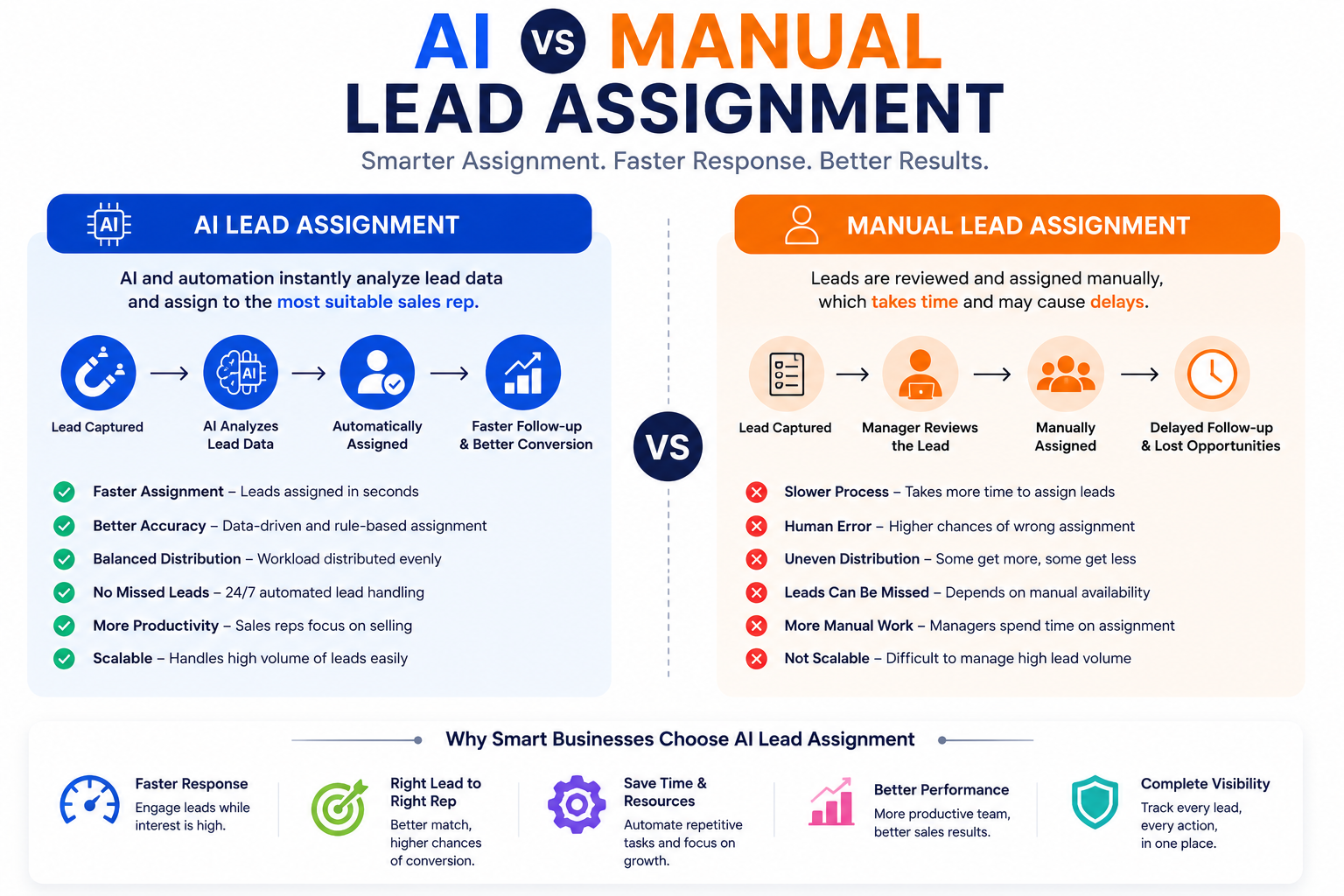
When a business receives only a few leads, assigning them manually may not be difficult. But as the number of leads increases, manual lead assignment can become time-consuming and difficult to manage.
This is where AI Lead Assignment can help.
AI and manual lead assignment both have their place, but they work very differently.
What Is Manual Lead Assignment?
Manual lead assignment means a manager or administrator reviews incoming leads and decides which salesperson should handle each one.
For example, a manager may check the lead's location, product requirement, or source and then forward the lead to a suitable sales agent.
This approach can work for smaller teams with a limited number of leads.
However, when lead volume increases, manual assignment can lead to delays, uneven distribution, and missed enquiries.
What Is AI Lead Assignment?
AI Lead Assignment uses AI, automation, and predefined business rules to help assign leads automatically.
The CRM can consider information such as:
- Lead location
- Product or service interest
- Lead source
- Sales territory
- Agent availability
- Customer requirements
- Team workload
The lead can then be assigned to the appropriate salesperson without requiring manual distribution for every enquiry.
AI vs Manual Lead Assignment
| Manual Lead Assignment | AI Lead Assignment |
|---|---|
| Requires manual work | Can automate lead distribution |
| Can take more time | Faster assignment |
| Depends on individual decisions | Uses data and defined rules |
| More difficult with high lead volume | Better suited for large lead volumes |
| Higher risk of assignment delays | Helps reduce delays |
| Difficult to monitor at scale | Easier to track through CRM |
Which One Is Better?
There is no single answer for every business.
Manual assignment can be suitable when a company has a small sales team and receives a limited number of leads.
AI or automated assignment becomes more useful when a business receives hundreds or thousands of leads and needs a faster, more structured process.
For growing sales teams, automation can reduce repetitive work and allow managers to focus more on sales performance rather than manually distributing enquiries.
Why AI Lead Assignment Is Useful
The main advantage of AI lead assignment is not simply automation. It is about creating a more consistent lead management process.
A typical workflow can be:
Lead Generated → Lead Captured → Lead Assigned → Follow-Up → Sales Opportunity → Conversion
With a CRM, managers can also track who received each lead, whether the lead was contacted, and how the opportunity progressed.
Conclusion
Manual lead assignment can work for small teams, but it becomes harder to manage as lead volume grows.
AI Lead Assignment helps businesses automate lead distribution, reduce delays, and organize the sales process more efficiently.
For businesses handling a large number of enquiries, combining AI with CRM automation can help sales teams spend less time assigning leads and more time converting them.
GreenCRM24 helps businesses manage leads, assignments, follow-ups, and sales activities from one centralized CRM platform.