Running a small business often means managing many things at once — finding new customers, following up with leads, handling sales, and keeping existing customers happy. When customer information is spread across spreadsheets, emails, WhatsApp conversations, and notes, it becomes easy to miss important follow-ups. This is where a CRM for small businesses can make a real difference.
Why Do Small Businesses Need a CRM?
A CRM is not only for large companies with big sales teams. Small businesses can also benefit from having a central system to manage their customer relationships.
Instead of asking, “Did someone follow up with this lead?”, your team can quickly check the lead's status, previous interactions, and next action.
A good CRM can help small businesses:
- Organise customer and lead information
- Track sales opportunities
- Manage follow-ups
- Assign leads to team members
- Monitor sales performance
- Reduce manual work
- Improve customer communication
The key is choosing a CRM that is simple enough for your team to use regularly without adding unnecessary complexity.
What Features Should a Small Business CRM Have?
The best CRM for a small business depends on its specific needs, but some features are particularly useful.
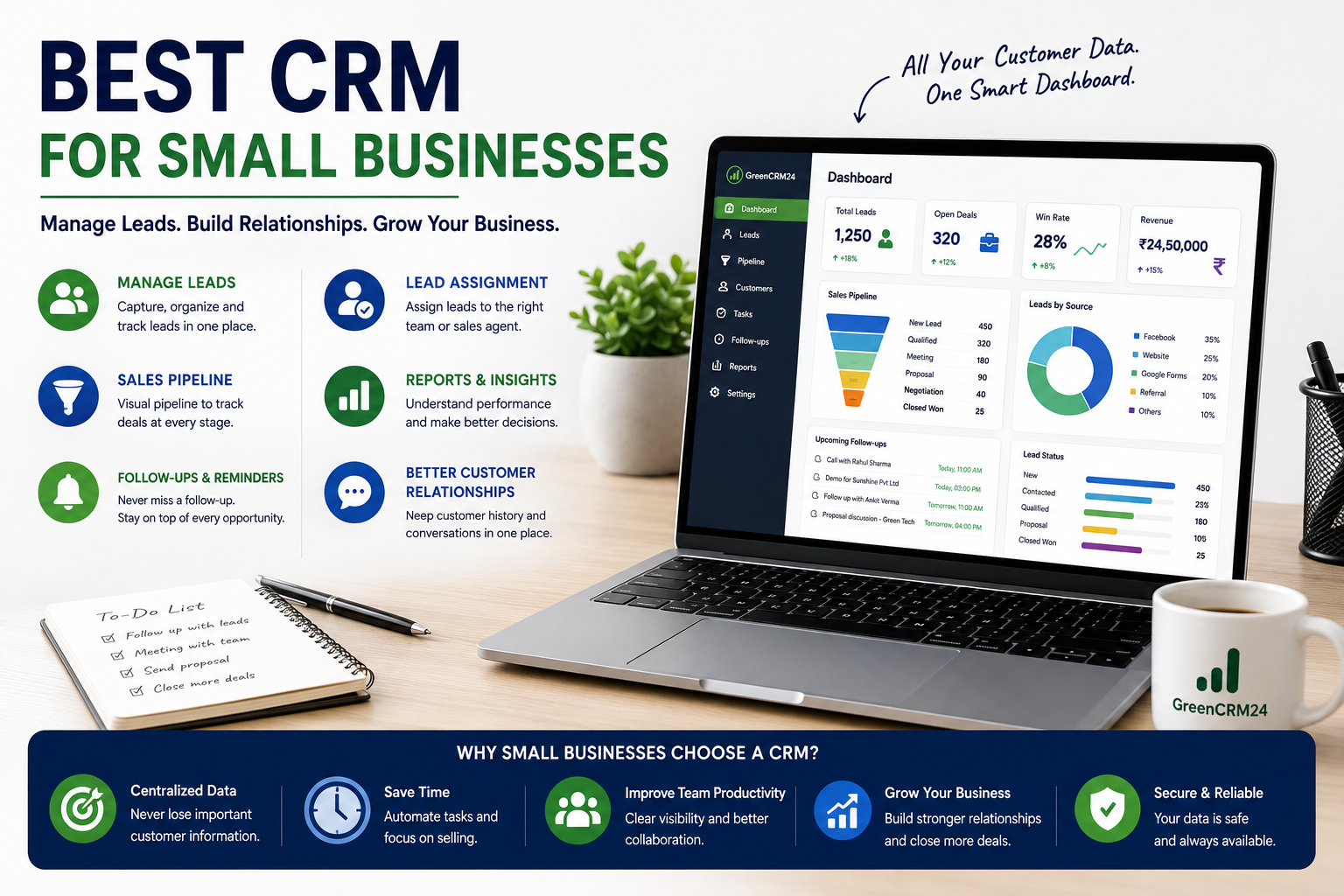
1. Lead Management
Your CRM should make it easy to capture, organise, and track leads from different sources. This helps your team avoid losing potential customers.
2. Sales Pipeline Management
A visual sales pipeline lets your team see where each opportunity stands — from new lead and qualification to proposal, negotiation, and closed deal.
3. Follow-Up Management
Missed follow-ups can result in lost sales. A CRM should help your team set reminders and keep track of the next action for every opportunity.
4. Lead Assignment
If you have multiple salespeople, leads should be assigned quickly and clearly. This reduces confusion and helps ensure that every enquiry has an owner.
5. Reports and Analytics
Basic reports can help you understand the number of leads, active deals, conversion rates, team performance, and overall pipeline health.
Why GreenCRM24 Can Be a Good Choice
When choosing a CRM, small businesses should look for a platform that combines useful features with an easy-to-manage workflow.
GreenCRM24 is designed to help teams capture leads, assign them to sales agents, manage follow-ups, and track lead performance from a central dashboard. It supports lead capture from sources such as Facebook, Google Forms, Shopify, manual entry, and Excel uploads.
GreenCRM24 also provides features such as smart lead assignment, agent follow-ups, real-time admin visibility, sales pipeline management, and analytics. These features can be useful for small and growing teams that want to move away from scattered spreadsheets and manual lead tracking.
How to Choose the Best CRM for Your Business
Before selecting a CRM, think about your actual sales process rather than choosing a platform simply because it has the most features.
Ask yourself:
- How do we currently capture leads?
- How many people manage our sales?
- Do we need automated follow-up reminders?
- Can our team learn and use the CRM easily?
- Does it integrate with the tools we already use?
- Can it grow with our business?
A short free trial can also help you understand whether the CRM fits your team's daily workflow.
Final Thoughts
The best CRM for small businesses is not necessarily the one with the longest feature list. It is the one that helps your team organise leads, follow up consistently, manage sales opportunities, and understand business performance without unnecessary complexity.
For a growing business, the right CRM can turn scattered customer information into an organised sales process — helping your team spend less time managing data and more time building customer relationships.