
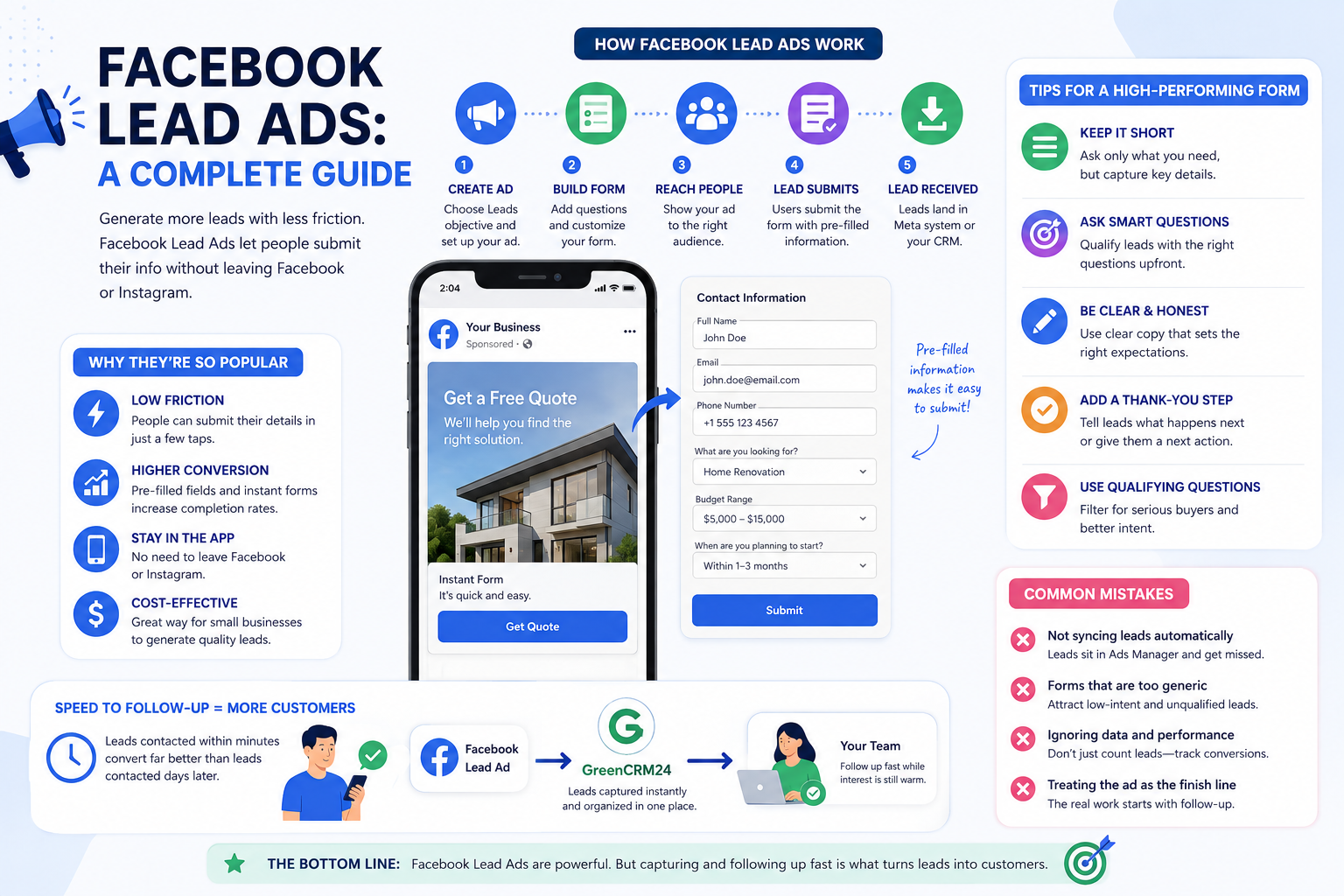
Facebook Lead Ads are a popular way for small businesses to generate leads directly through Facebook and Instagram. They make it easy for users to submit their contact details, but businesses need the right setup and follow-up process to convert those leads effectively.
What Are Facebook Lead Ads, Exactly?
A Facebook Lead Ad is a type of ad format that lets someone submit their contact information without ever leaving Facebook or Instagram. Instead of clicking through to your website and filling out a form there, the form opens right inside the app — and a lot of the fields (name, email, phone number) are pre-filled automatically, based on what the person already has in their Facebook profile.
That's the whole point of the format: remove as much friction as possible between "seeing the ad" and "submitting interest."
Why They're So Popular
Compare this to a traditional ad that sends someone to your website. That person has to click, wait for the page to load, find the form, manually type in their details, and hit submit. Every one of those steps is a chance for someone to lose interest and drop off.
With Lead Ads, someone can go from seeing your ad to submitting their info in a couple of taps — often without even leaving the app they're scrolling through. That drop in friction usually means a meaningfully higher form completion rate compared to sending traffic to an external landing page.
For small businesses without a heavily optimized website or landing page, this matters a lot. You don't need a beautifully designed page to get decent lead volume — Facebook's native form does a lot of the heavy lifting.
How Facebook Lead Ads Actually Work
Here's the basic flow:
- You create the ad inside Meta Ads Manager, choosing "Leads" as your campaign objective.
- You build the instant form — this includes your headline, a short description, and the questions you want to ask (name, phone, email, plus any custom questions).
- The ad runs on Facebook and/or Instagram, targeted to whatever audience you've chosen.
- Someone taps the ad, the form pops up pre-filled with their profile info, and they hit submit.
- The lead lands in Meta's system, viewable inside Ads Manager — or, ideally, somewhere it can be followed up on immediately.
That last step is where most of the real-world problems actually happen, and we'll get to that shortly.
Setting Up a Good Lead Form
Not all Lead Ad forms perform equally, and a few choices make a real difference:
Keep the form short — but not too short. Every extra field reduces completions. But a form that's too short (just name and email) tends to attract low-intent leads who tapped through without much thought. A short list of qualifying questions — budget range, timeline, what they're looking for — filters for people who are actually serious, at the cost of a slightly lower completion rate. That trade-off is usually worth it.
Write a clear, honest headline and description. Vague or clickbait-y copy attracts vague, low-intent leads. Being specific about what you're offering attracts people who actually want that thing.
Add a thank-you screen with a next step. After someone submits, Facebook shows a confirmation screen. Use it — tell them what happens next ("we'll call you within 24 hours") or give them a way to take immediate action (like a link to book a call directly).
Use Facebook's built-in qualifying questions where relevant. These help filter intent without adding much friction, since they're often quick multiple-choice selections rather than typed answers.
The Problem Nobody Warns You About
Here's the part that catches a lot of businesses off guard: Facebook Lead Ads generate leads inside Facebook's own system — not automatically inside your CRM, your inbox, or wherever your sales team actually works.
That means, by default, someone has to manually go into Ads Manager, download the leads (often as a CSV), and then get that information to whoever's supposed to follow up. If nobody's doing that consistently — checking daily, exporting, distributing — leads can sit there for days without anyone even realizing they came in.
This is a genuinely common failure point. A business runs a great campaign, gets a strong number of leads, and then quietly loses most of them simply because nobody was checking the dashboard regularly enough. The ad worked. The follow-up process didn't.
Why Speed of Follow-Up Matters So Much Here
Because Lead Ads are low-friction by design, a lot of people tap through in a fairly casual, low-commitment moment — scrolling, half-distracted, on their phone. That interest is real, but it fades fast if nobody follows up quickly. A lead contacted within minutes behaves very differently from the same lead contacted three days later, by which point they've probably forgotten they even filled out the form.
This is exactly why connecting Lead Ads directly to a system that captures leads automatically matters so much. If leads flow straight from Facebook into a CRM the moment they're submitted — the way GreenCRM24 connects directly to Facebook Lead Ads without needing a separate tool like Zapier in between — your team can reach out while that initial interest is still warm, instead of discovering the lead days later in an export file.
A Few Common Mistakes
Not syncing leads anywhere automatically. Relying on manually checking Ads Manager is the single biggest reason Lead Ads underperform for small businesses — not the ad itself, but what happens (or doesn't) after.
Making the form too generic. A form asking only for a name and phone number, with no context about intent, tends to produce a lot of low-quality submissions that waste the sales team's time.
Ignoring the data over time. Facebook Lead Ads campaigns need regular review — which audiences are converting into actual customers, not just form fills, and which are just generating cheap, low-intent volume.
Treating the ad as the finish line. The ad's job is just to generate interest. The real work — qualifying, following up, closing — happens after, and that part needs just as much attention as the campaign itself.
The Bottom Line
Facebook Lead Ads are genuinely one of the most effective, low-cost ways for a small business to generate leads — the low-friction format alone tends to outperform sending people to an external landing page. But the format's biggest strength (removing friction) is also where its biggest risk lives: leads come in fast and easy, and if there's no system catching them the moment they arrive, that speed advantage gets completely wasted.
The ad brings the lead to the door. What happens in the next few minutes is what actually decides whether that lead becomes a customer.