
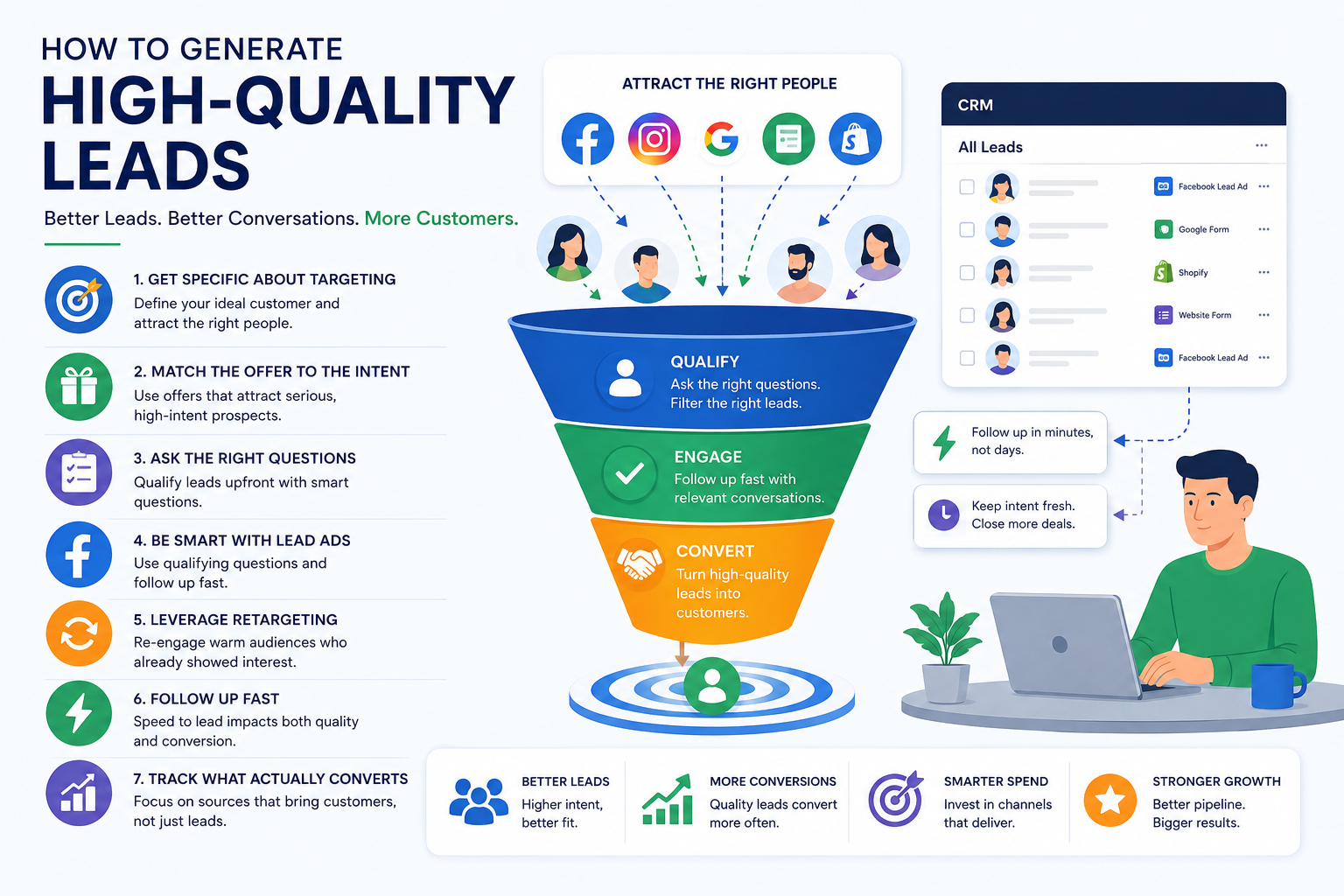
The real challenge for many businesses isn’t generating more leads—it’s generating quality leads that are genuinely interested and likely to become customers. Focusing on the right audience helps sales teams spend less time chasing unqualified prospects and more time converting valuable opportunities.
What Makes a Lead "High-Quality" in the First Place?
A high-quality lead isn't just someone who filled out a form. It's someone who:
- Actually fits your target customer (right budget, right need, right timing)
- Showed genuine intent, not just idle curiosity
- Is realistically likely to convert with the right follow-up
Compare two leads: one person clicked an ad out of boredom and filled in a fake-sounding email to see a discount code. Another person searched specifically for your product, read your pricing page, and then filled out a "request a quote" form. Both are technically "leads." Only one of them is worth your team's time.
1. Get Specific About Who You're Targeting
This is the single biggest lever for lead quality, and it's the one most commonly skipped. A vague target audience ("people who might like our product") produces vague leads. A specific one produces leads who are actually a fit.
Instead of targeting broadly, get precise about:
- What problem does your product actually solve, and for whom?
- What does someone's situation look like right before they need you?
- What would make someone a bad fit, even if they're technically interested?
That last question matters more than people think. Knowing who isn't your customer helps you avoid wasting ad spend and follow-up time on people who were never going to convert.
2. Match the Offer to the Intent
Not every lead magnet attracts the same kind of person. A "free ebook" tends to pull in casual, low-intent browsers. A "book a demo" or "get a quote" form tends to pull in people who are seriously considering a purchase.
Neither is wrong — they just serve different purposes. If your goal is high-quality, sales-ready leads, your offer should ask for a bit more commitment, not less. Something like "get a personalized quote" filters out casual clickers far better than "learn more."
3. Ask the Right Questions Upfront
A short form gets more submissions. But a slightly longer, smarter form gets better submissions. Adding a couple of targeted qualifying questions — budget range, timeline, company size, specific need — does two things:
- It filters out people who clearly aren't a fit before they even become a lead
- It gives your sales team useful context the moment they follow up, instead of starting cold
The trick is balance. Ask too much, and you'll scare off genuinely interested people. Ask too little, and every lead looks the same on paper, good or bad.
4. Be Careful With Facebook Lead Ads Specifically
Facebook and Instagram Lead Ads are powerful because they remove friction — someone can submit their info without ever leaving the app, which massively increases form completions. But that same low friction is a double-edged sword: it also makes it incredibly easy for someone to tap through half-interested, without really meaning to follow through.
This doesn't mean avoid them — it means be deliberate. Use qualifying questions within the form itself, and make sure whoever follows up does it fast, while the person still remembers clicking. A lead from a Lead Ad that's contacted within minutes converts very differently than one that sits untouched for three days.
5. Don't Underestimate Retargeting
Some of the highest-quality leads aren't strangers at all — they're people who already visited your website, looked at your pricing page, or added something to their Shopify cart and left. These people already have context and intent; they just didn't take the final step.
Retargeting ads aimed specifically at these warmer audiences tend to produce leads that convert noticeably better than cold, broad targeting — because you're not introducing your business from scratch, you're re-engaging someone who was already close.
6. Follow Up Fast — This Actually Affects Quality, Not Just Conversion
Here's something that surprises people: lead quality isn't only determined at the moment of capture. It's also shaped by what happens right after.
A genuinely interested lead can turn "cold" simply because nobody reached out in time. By the time someone finally calls three days later, that same high-intent lead has often already moved on, gone with a competitor, or lost the urgency they had in the moment.
This is exactly why lead generation and CRM go hand in hand. It doesn't matter how well-targeted your ads are if the leads they generate sit unanswered in an inbox or an ads dashboard nobody checks. When leads flow automatically into one place the moment they come in — the way GreenCRM24 pulls leads directly from Facebook Lead Ads, Google Forms, and Shopify — your team can follow up within minutes instead of days, while that intent is still fresh.
7. Track Which Sources Actually Convert — Not Just Which Generate the Most Leads
It's tempting to judge a campaign by how many leads it brought in. But the number that actually matters is how many of those leads turned into customers. A channel that brings in 50 leads with a 2% conversion rate is doing worse than one that brings in 15 leads with a 20% conversion rate — even though the first one "looks" more productive on paper.
This is where having leads organized in one system pays off. If every lead is tagged by source, you can actually see which channels are producing real customers, and shift budget and effort away from the ones that just produce noise.
The Bottom Line
Generating a lot of leads is easy. Generating leads that are actually worth following up with takes more intention — knowing exactly who you're targeting, asking for the right level of commitment upfront, and following up fast enough that intent doesn't fade.
Quality beats quantity almost every time. A smaller number of well-targeted, quickly-followed-up leads will consistently outperform a flood of leads nobody has time to properly work through.