
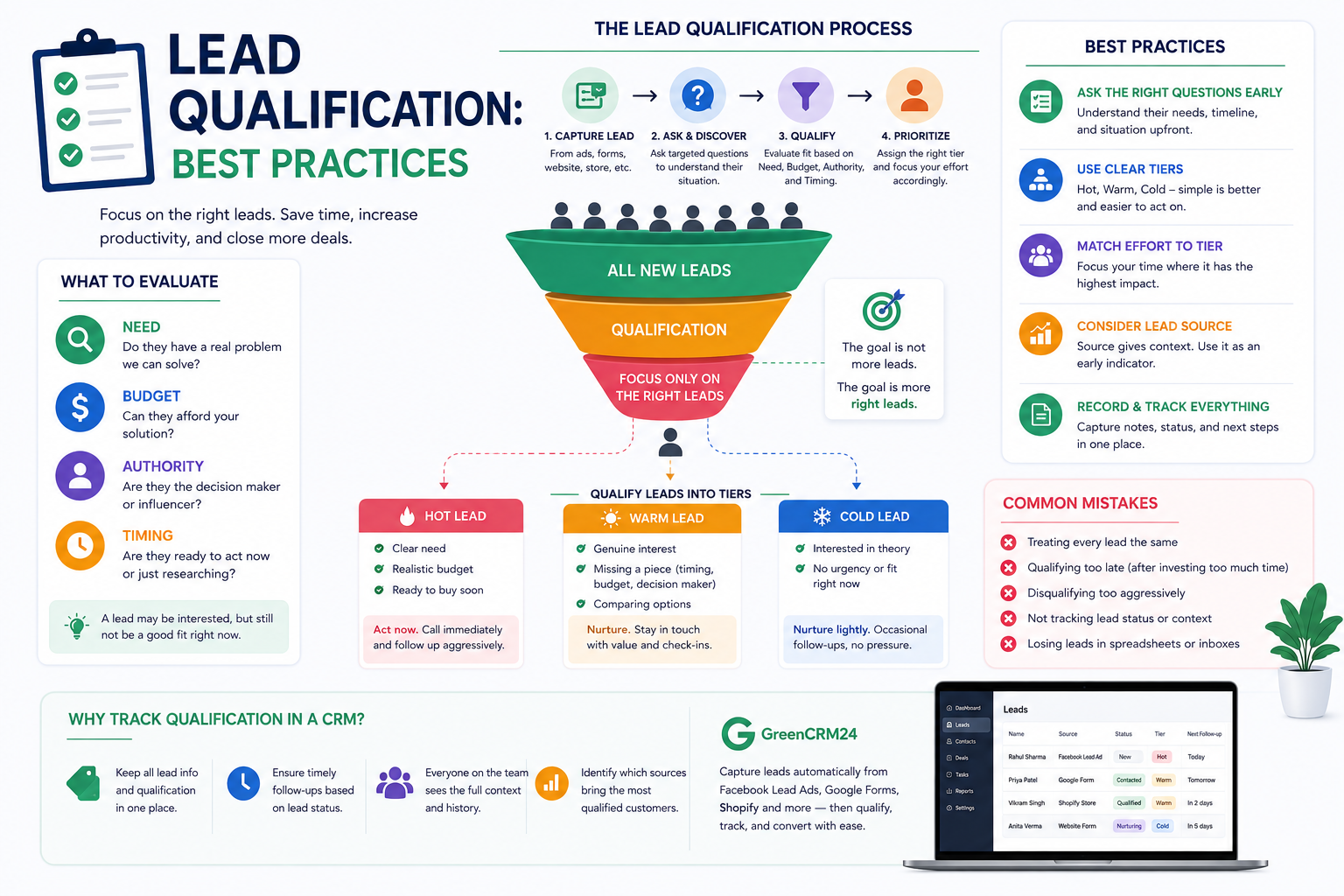
Lead qualification helps sales teams identify which leads are most likely to buy and prioritize their time accordingly. By focusing more effort on high-potential leads and less on low-intent prospects, businesses can reduce wasted follow-ups and improve conversions.
What Lead Qualification Actually Means
At its core, qualifying a lead means answering a simple question: is this person actually a good fit, and are they realistically likely to buy? That usually comes down to a handful of factors:
- Need — Do they actually have the problem your product solves?
- Budget — Can they realistically afford what you're offering?
- Authority — Are they the person who makes the decision, or at least influences it?
- Timing — Are they looking to act now, or just browsing for someday?
This is often taught as the "BANT" framework (Budget, Authority, Need, Timing), and while the acronym feels a bit dated, the underlying logic still holds up. A lead can be genuinely interested and still be a bad use of your time right now if the timing or budget just isn't there yet.
Why Skipping This Step Costs More Than It Seems
It's tempting to treat every lead as equally worth a full sales push — after all, you paid to generate that lead, so shouldn't you chase it fully? But that instinct usually backfires. Chasing every lead with the same intensity means your team spends just as much time on someone who was never going to buy as they do on someone who's actually ready.
The businesses that qualify well end up with a smaller number of active leads at any given time — but a much higher percentage of them actually convert. That's a better outcome than a packed pipeline full of people who never respond after the first call.
A Simple Way to Qualify Leads
You don't need an elaborate scoring system to start. A practical, low-effort approach:
1. Ask a few targeted questions early. Whether it's in the lead form itself or the first call, a couple of well-placed questions tell you a lot: What are you looking for? What's your timeline? What's prompting you to look into this now? Vague, non-committal answers are often a sign of a low-intent lead. Specific answers usually mean someone's actually further along.
2. Sort leads into rough tiers. You don't need ten categories — three is usually enough:
- Hot — clear need, realistic budget, ready to move soon
- Warm — genuine interest, but missing a piece (unclear timing, needs approval from someone else, still comparing options)
- Cold — interested in theory, but no real urgency or fit right now
3. Match your follow-up effort to the tier. Hot leads get called immediately and followed up on aggressively. Warm leads get nurtured — a check-in every so often, useful info, no pressure. Cold leads go into a lighter, occasional follow-up rhythm, without pulling active attention away from the leads that are actually ready.
Where Most Businesses Get This Wrong
Treating every lead the same regardless of source. A lead who filled out a detailed "request a quote" form with a clear budget in mind is not the same as someone who tapped a Facebook Lead Ad half-distracted while scrolling. Source alone isn't a full qualification method, but it's a useful early signal worth factoring in.
Qualifying too late. Some teams only start qualifying after a full sales call, which means a lot of time gets spent before anyone realizes the lead was never a fit. Asking a couple of qualifying questions upfront — even right in the lead capture form — saves that wasted step.
Disqualifying too aggressively. The flip side is also a real risk. Someone who doesn't perfectly match your ideal profile today might still be worth a light-touch follow-up later — timing changes, budgets open up, decision-makers change their minds. Qualification should filter effort, not slam the door shut entirely.
Losing track of where each lead actually stands. This is the quiet killer. Without somewhere to record it, "warm" and "cold" labels exist only in someone's head — which means the moment that person is busy, out sick, or leaves the company, all that context disappears with them.
Why This Needs to Live Somewhere, Not Just in Someone's Head
Qualification only pays off if it's consistently tracked and acted on. If one rep mentally tags a lead as "not ready yet" but never records it anywhere, that context is gone the next time someone follows up — and the lead either gets ignored (when they were actually warming up) or chased too hard (when they'd already said no).
This is really where lead qualification and having an actual system come together. A CRM gives you a place to tag leads by status, note why they were qualified a certain way, and make sure the next follow-up reflects that — instead of every rep starting from scratch each time they open a conversation. Systems like GreenCRM24 that pull leads in automatically from Facebook Lead Ads, Google Forms, and Shopify also make it easier to qualify early, since the lead's source and initial details are already sitting there the moment someone picks it up — rather than someone having to dig that context up manually first.
The Bottom Line
Not every lead is worth the same amount of effort, and pretending otherwise just spreads your team's attention thin across people who were never going to convert. Good lead qualification isn't about being harsh or dismissive — it's about being honest, early, and consistent about where each lead actually stands, so the right amount of energy goes to the right people at the right time.
A smaller, well-qualified pipeline will almost always outperform a large, unsorted one. It's just a matter of building the habit of asking the right questions early, and actually keeping track of the answers.