
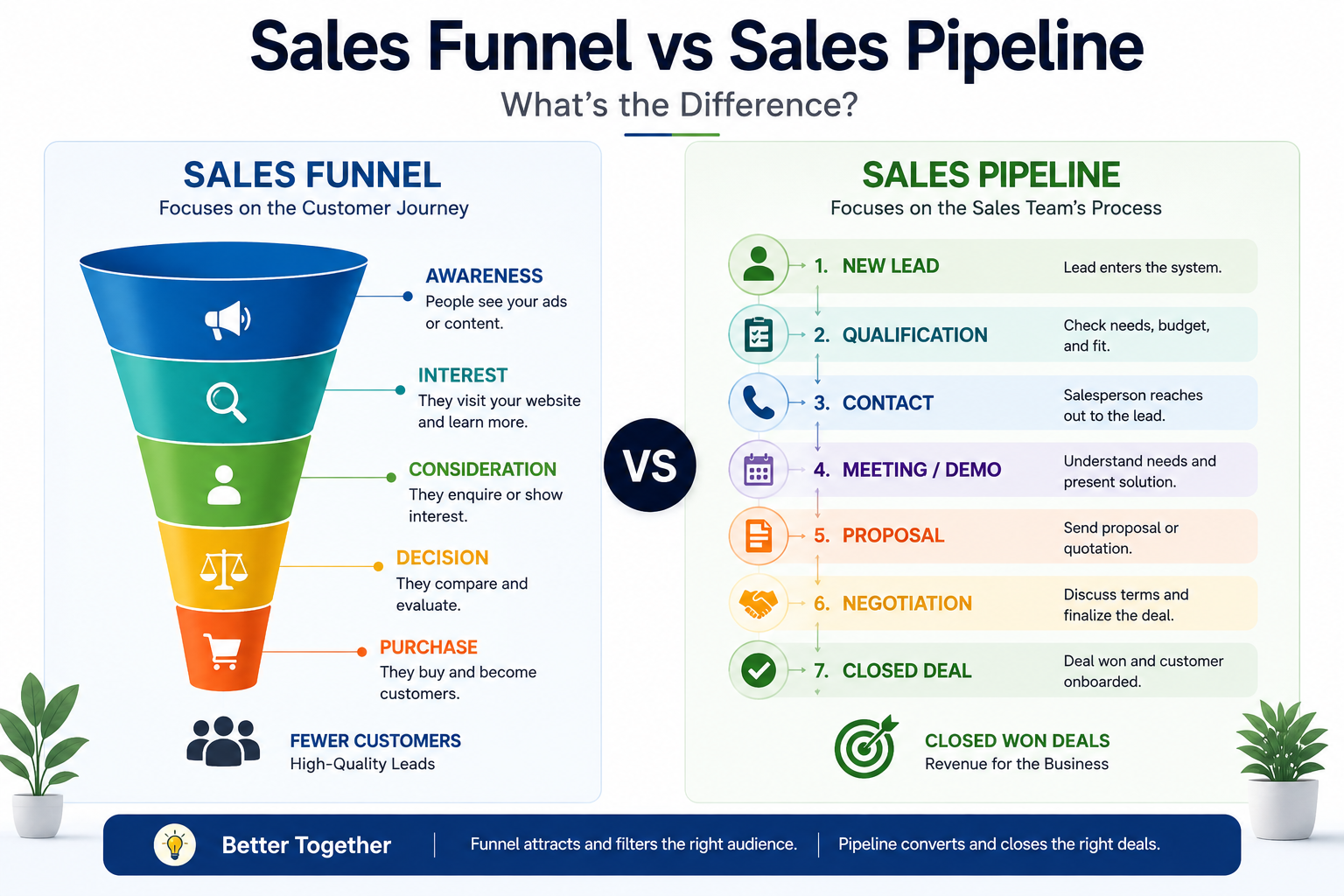
If you work in sales or marketing, you have probably heard the terms sales funnel and sales pipeline. They are closely related, but they are not the same thing. Both help businesses understand the sales process, but they look at it from different perspectives. A sales funnel focuses on the customer journey, while a sales pipeline focuses on the sales team’s activities and deal progress.
What Is a Sales Funnel?
A sales funnel represents the journey a potential customer takes before becoming a customer. It starts with a large number of people who may be interested in a product or service and gradually becomes smaller as people move closer to making a purchase.
A typical sales funnel may include:
Awareness → Interest → Consideration → Decision → Purchase
For example, 1,000 people may see an advertisement, 200 may visit the website, 50 may enquire, and 10 may finally become customers.
The sales funnel helps businesses understand how many potential customers are moving through each stage and where people are dropping off.
What Is a Sales Pipeline?
A sales pipeline shows the stages a sales opportunity moves through from the sales team's perspective.
A typical sales pipeline may look like:
New Lead → Qualification → Contact → Meeting/Demo → Proposal → Negotiation → Closed Deal
For example, when a lead submits an enquiry, the salesperson may qualify the lead, schedule a meeting, send a proposal, negotiate the terms, and finally close the deal.
The sales pipeline helps sales teams understand which deals are active, what action is required next, and how close each opportunity is to closing.
Sales Funnel vs Sales Pipeline
The easiest way to understand the difference is to look at their main purpose.
Sales Funnel: Focuses on the customer's journey.
Sales Pipeline: Focuses on the sales team's process.
A funnel measures how potential customers move toward a purchase, while a pipeline tracks how sales opportunities are managed and progressed.
For example, a marketing team may use a sales funnel to measure how many people move from an advertisement to an enquiry. The sales team can then use a pipeline to track those enquiries through calls, meetings, proposals, negotiations, and closing.
Why Are Both Important?
Businesses can benefit from using both a sales funnel and a sales pipeline.
The sales funnel helps marketing and management understand the overall customer journey. It can show where potential customers lose interest and which marketing activities generate better results.
The sales pipeline helps salespeople manage individual opportunities. It makes it easier to organise leads, plan follow-ups, prioritise important deals, and monitor expected revenue.
When both are used together, businesses get a clearer picture of the entire sales process — from attracting potential customers to closing deals.
How CRM Software Can Help
Managing leads and sales opportunities manually can become difficult as a business grows. This is where CRM software can help.
A CRM can help businesses track leads, manage pipeline stages, schedule follow-ups, record customer interactions, and monitor sales performance from one place.
It can also provide useful reports that help managers understand conversion rates, pipeline value, sales performance, and potential revenue.
Final Thoughts
The main difference between a sales funnel and sales pipeline is simple: the funnel looks at the process from the customer's perspective, while the pipeline looks at it from the sales team's perspective.
Both are valuable tools for businesses. Using them together can help your team understand customer behaviour, manage sales opportunities more effectively, and create a more organised path from lead to customer.