
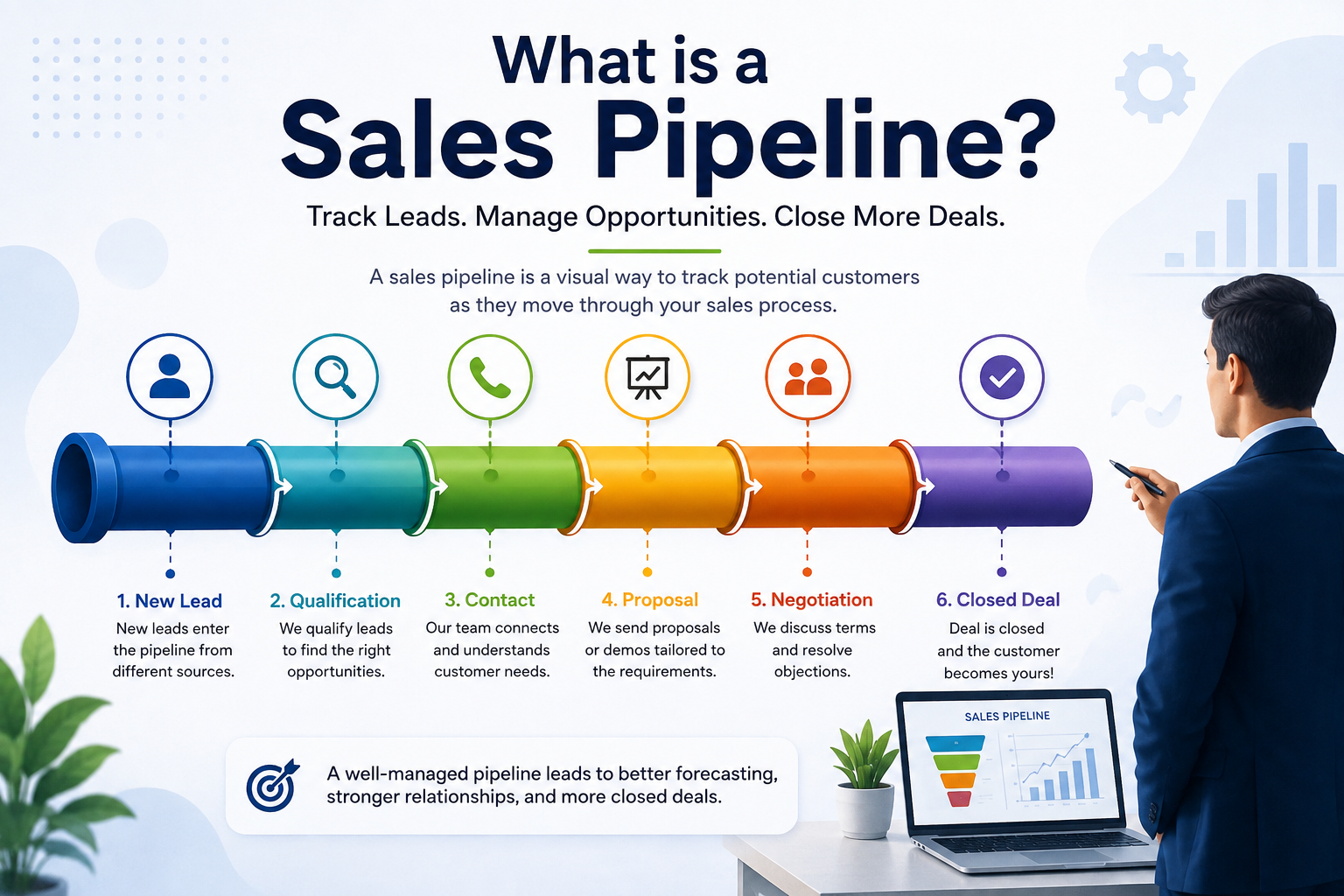
A sales pipeline helps businesses track potential customers through each stage of the sales process. It shows which leads are active, what action is needed next, and how close they are to becoming customers. In simple terms, it helps sales teams organise leads, manage follow-ups, and close more deals efficiently.
Why a Sales Pipeline Important?
Without a proper system, sales teams can easily lose track of leads, follow-ups, and potential deals.
A sales pipeline helps businesses:
- Keep all sales opportunities organised
- Track every lead's progress
- Schedule timely follow-ups
- Identify high-potential leads
- Understand expected sales
- Improve sales team productivity
- Find problems in the sales process
It also helps sales managers understand how many opportunities are currently active and which deals are most likely to close.
What Are the Stages of a Sales Pipeline?
Every business can create its own sales pipeline, but most pipelines include similar stages.
1. New Lead
This is when a potential customer first contacts your business or responds to your marketing campaign.
Leads can come from websites, social media, advertisements, referrals, phone calls, or other sources.
2. Lead Qualification
Not every lead is ready to buy. At this stage, the salesperson checks the customer's requirements, budget, interest, and buying timeline.
The goal is to identify which leads are worth pursuing.
3. Contact or Meeting
The salesperson contacts the qualified lead to understand their requirements and answer their questions.
Depending on the business, this could be a phone call, meeting, product demo, or property visit.
4. Proposal or Negotiation
If the customer is interested, the salesperson may share a quotation, proposal, pricing, or other details.
The customer may then ask questions or negotiate before making a decision.
5. Closed Deal
The final stage is when the customer makes a purchase.
The opportunity can be marked as Closed Won if the sale is completed or Closed Lost if the customer decides not to proceed.
Sales Pipeline Example
Let's take a simple example of a real estate business.
A company receives 100 property enquiries.
The sales pipeline might look like:
100 New Leads → 60 Qualified Leads → 30 Site Visits → 15 Negotiations → 5 Bookings
This gives the sales team a clear understanding of how leads are progressing.
If many leads are getting stuck before the site visit stage, the company can investigate the reason and improve its sales process.
Sales Pipeline vs Sales Funnel
A sales pipeline and sales funnel are related but have different purposes.
A sales pipeline focuses on the stages and actions involved in moving a potential customer toward a purchase.
A sales funnel focuses more on the customer's journey and shows how the number of potential customers decreases at each stage.
For example:
Sales Pipeline:
Lead → Qualification → Meeting → Proposal → Negotiation → Closing
Sales Funnel:
100 Leads → 50 Interested → 20 Qualified → 5 Customers
Both are useful for understanding and improving the sales process.
How CRM Helps Manage a Sales Pipeline
Managing a sales pipeline manually can become difficult when a business has hundreds or thousands of leads.
This is where CRM software can help.
A CRM allows sales teams to keep lead information, follow-ups, conversations, activities, and deal stages in one place.
With a CRM, businesses can:
- Track leads and opportunities
- Set follow-up reminders
- Assign leads to salespeople
- Monitor deal progress
- Track sales performance
- Identify leads that need attention
- Generate sales reports
Instead of relying on spreadsheets or remembering every follow-up manually, the sales team gets a centralised view of the entire sales pipeline.
Common Sales Pipeline Mistakes
Some common mistakes can reduce the effectiveness of a sales pipeline:
Not updating lead status: Outdated information makes the pipeline unreliable.
Missing follow-ups: A good lead can be lost simply because nobody followed up at the right time.
Too many stages: A complicated pipeline can confuse the sales team.
Treating every lead equally: Some leads are highly interested while others are only exploring. Prioritising leads can help salespeople use their time better.
Conclusion
A sales pipeline helps businesses understand where their leads are, what needs to happen next, and which opportunities are closest to conversion.
When combined with a CRM, sales pipeline management becomes easier, more organised, and more measurable.