
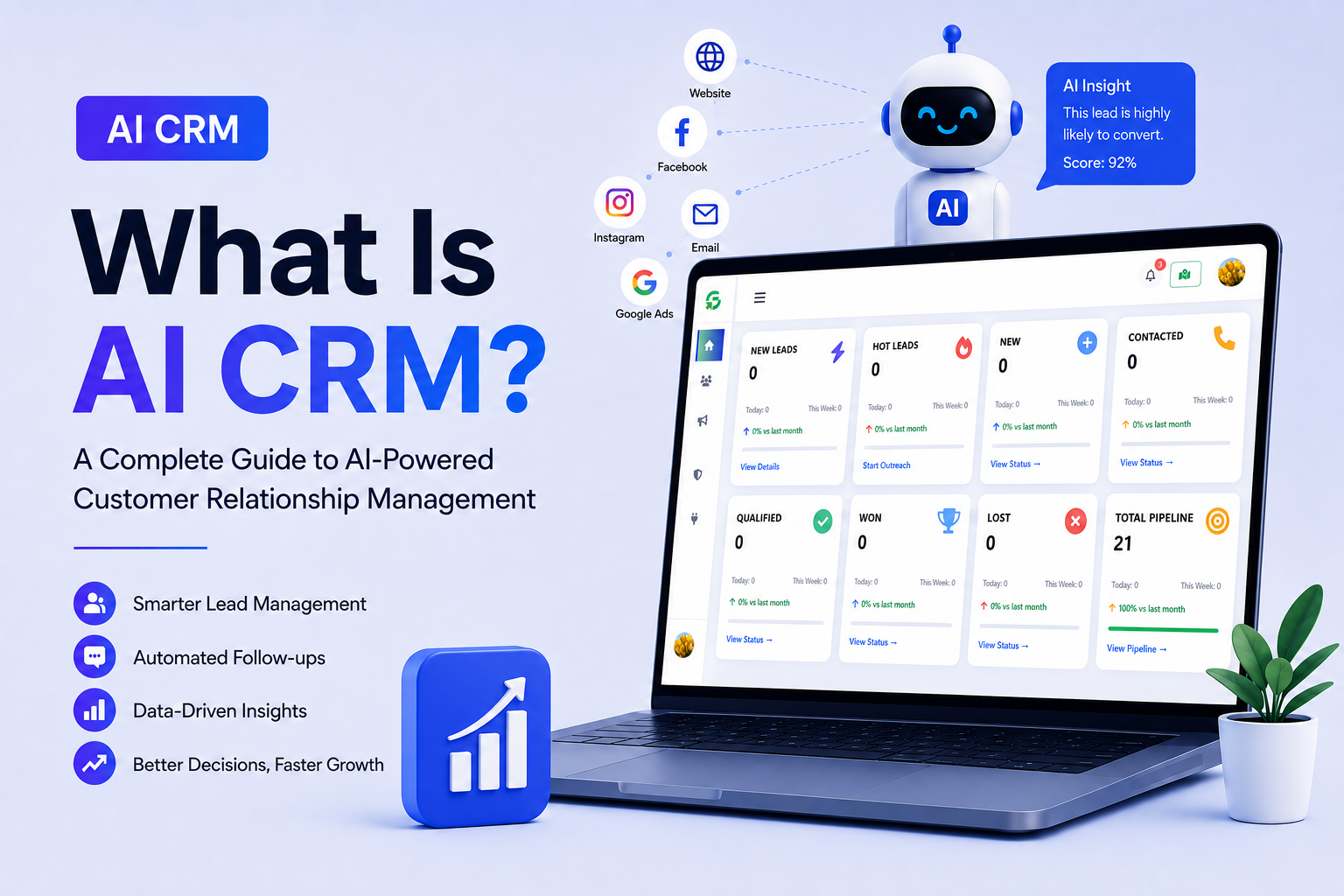
Businesses today receive customer enquiries from many different channels, including websites, social media, online forms, email, advertisements, and e-commerce platforms. Managing all these leads manually can become difficult as the business grows.
This is where AI CRM comes into the picture.
An AI CRM combines traditional Customer Relationship Management (CRM) with Artificial Intelligence (AI) to help businesses manage customer data, understand sales activities, automate repetitive tasks, and make better decisions.
But what exactly is AI CRM, how does it work, and why are businesses increasingly using it?
Let's understand it in simple terms.
What Is AI CRM?
AI CRM stands for Artificial Intelligence Customer Relationship Management.
An AI CRM is a CRM system that uses artificial intelligence to analyze customer and sales data, automate routine activities, identify patterns, and provide useful insights to sales and marketing teams.
A traditional CRM mainly helps businesses store and organize customer information. An AI-powered CRM can go a step further by using that information to help teams decide what to do next.
For example, instead of simply showing a salesperson that a lead has not been contacted for three days, an AI-powered CRM can identify the lead as requiring attention and recommend a follow-up.
Modern AI CRM platforms can support activities such as lead scoring, customer data analysis, follow-up recommendations, sales forecasting, communication assistance, and workflow automation.
In simple words:
Traditional CRM stores information. AI CRM helps businesses understand and act on that information.
How Does an AI CRM Work?
An AI CRM works by combining customer information with AI-based analysis and automation.
A typical process looks like this:
Lead Capture → Data Analysis → Lead Prioritization → Automated Follow-up → Sales Tracking → Insights
For example, imagine a company receives 500 enquiries in a month.
A traditional CRM can store those 500 leads and allow the sales team to track them.
An AI CRM can analyze available information and help the team identify which leads may need immediate attention, which leads have not received follow-up, and where opportunities may be getting delayed.
The exact capabilities depend on the CRM platform and the quality of the data available.
Key Features of AI CRM
1. AI-Powered Lead Management
AI can help sales teams organize and prioritize leads based on available customer and sales information.
Instead of treating every lead exactly the same, businesses can use AI-driven insights to focus their efforts where they may have the greatest opportunity.
This can be particularly useful for businesses handling a large number of enquiries every month.
2. Lead Scoring and Prioritization
One of the important applications of AI in CRM is lead scoring.
AI can analyze patterns in customer and sales data to help identify leads that may be more likely to move forward.
Sales teams can then spend more time on high-priority opportunities instead of manually checking every lead.
However, AI recommendations should be treated as decision-support rather than a replacement for human judgment.
3. Automated Follow-Ups
Following up with customers consistently is an important part of the sales process.
AI CRM software can help identify pending follow-ups, create reminders, and automate certain workflows.
This reduces the possibility of leads being forgotten because a salesperson was busy with other tasks.
4. Customer Data Analysis
A CRM contains valuable information about customers, leads, conversations, activities, and sales opportunities.
AI can analyze this information and identify useful patterns.
For example, businesses may discover:
- Which sources generate more leads
- Which leads are receiving delayed responses
- Which sales stages have the highest drop-off
- Which sales representatives need additional support
- Which opportunities may require attention
This turns CRM data into actionable business information.
5. Sales Forecasting
AI can also support sales forecasting by analyzing historical and current sales data.
Sales managers can use these insights to understand pipeline movement and make more informed decisions.
Forecasting accuracy will depend on factors such as data quality, sales history, business processes, and the AI model being used.
6. AI-Assisted Communication
Some AI CRM platforms can help sales teams create emails, summarize conversations, prepare responses, or generate follow-up messages.
This can save time, especially when sales representatives communicate with a large number of customers.
The salesperson can review and personalize AI-generated content before sending it to the customer.
7. Sales Team Performance Tracking
AI-powered CRM systems can help managers understand team activity and sales performance.
Managers can monitor metrics such as:
- Number of leads received
- Leads assigned to each agent
- Follow-up activity
- Lead status
- Conversion rates
- Pending enquiries
- Sales pipeline
This creates better visibility across the sales process.
AI CRM vs Traditional CRM
The main difference is how the system uses customer information.
| Traditional CRM | AI CRM |
|---|---|
| Stores customer information | Stores and analyzes customer information |
| Tracks leads | Helps prioritize leads |
| Records activities | Identifies patterns in activities |
| Manual follow-up management | Can automate or recommend follow-ups |
| Basic reporting | AI-assisted insights and analysis |
| Requires more manual work | Can automate repetitive tasks |
| Mainly reactive | Can provide proactive recommendations |
This does not mean traditional CRM systems are outdated. A good CRM provides the foundation for customer data and sales management, while AI can add another layer of analysis, automation, and decision support.
What Are the Benefits of AI CRM?
AI CRM can provide several benefits for growing businesses.
Save Time
Sales teams often spend significant time entering data, checking lead status, preparing reports, and managing follow-up activities.
AI and automation can reduce some of this repetitive work.
Respond to Leads Faster
When businesses receive a high volume of enquiries, responding quickly becomes challenging.
A well-configured CRM can help capture leads, assign them to the appropriate salespeople, and keep follow-up activities organized.
Improve Lead Management
AI-based insights can help sales teams identify which leads need attention and reduce the chances of opportunities being overlooked.
Better Sales Visibility
Managers can get a clearer view of lead status, team activity, sales pipeline, and customer interactions.
Make Data-Driven Decisions
Instead of relying only on assumptions, managers can use CRM data and AI-generated insights to support their decisions.
Improve Customer Experience
When customer information and previous interactions are available in one place, sales teams can provide more relevant and consistent communication.
Who Can Benefit From AI CRM?
AI CRM can be useful for many types of businesses, especially organizations that handle a high volume of leads or customer interactions.
It can be particularly useful for:
- Real estate companies
- Digital marketing agencies
- Sales organizations
- Education and training companies
- Financial service businesses
- E-commerce businesses
- Call centers
- Insurance companies
- B2B companies
- Customer service teams
For businesses receiving thousands of leads every month, having a structured system for lead capture, assignment, follow-up, and tracking can become especially important.
AI CRM for Sales Teams
Sales teams often face a common problem: too many leads and not enough time.
Leads may come from Facebook, Google, websites, forms, phone calls, advertisements, or other channels.
If these leads are managed through spreadsheets or different systems, important information can easily be missed.
An AI-powered CRM can bring customer and lead information into one centralized system while using automation and AI-based insights to support the sales process.
For example:
New Lead → Lead Captured → Lead Assigned → Sales Agent Contacts Customer → Follow-Up → Opportunity → Conversion
A CRM platform such as GreenCRM24 is designed around this type of lead-management workflow, including lead capture, lead assignment, agent follow-ups, and administrative visibility.
Is AI CRM Going to Replace Salespeople?
No.
The purpose of AI CRM is generally to support salespeople, not replace them.
AI can handle repetitive activities, analyze information, identify patterns, and provide recommendations. Salespeople still play an important role in understanding customer requirements, building relationships, handling objections, negotiating, and closing deals.
The best results usually come when AI and human expertise work together.
What Should You Look for in an AI CRM?
Before choosing an AI CRM software, businesses should consider their actual requirements.
Look for features such as:
- Lead capture from multiple sources
- Automatic lead assignment
- Lead scoring
- Follow-up reminders
- Workflow automation
- Customer interaction tracking
- Sales pipeline management
- Reporting and analytics
- Team performance tracking
- AI-powered insights
- Integration with existing business tools
- Data security and access controls
- Easy-to-use interface
Most importantly, don't choose an AI CRM simply because it has the word "AI" in its marketing.
The software should solve real business problems and fit naturally into your team's existing sales process.
The Future of AI CRM
AI is changing the way businesses manage customer relationships.
Modern CRM platforms are moving beyond simply storing contact information. AI is increasingly being used for automation, predictive insights, communication assistance, sales analysis, and proactive recommendations.
As AI technology develops, CRM systems are likely to become more helpful in understanding customer behavior and supporting sales teams throughout the customer journey.
For businesses, the goal should not simply be to "use AI." The real goal is to use AI where it can save time, improve processes, and help employees make better decisions.
Conclusion
AI CRM is the combination of Customer Relationship Management and Artificial Intelligence.
While traditional CRM software helps businesses organize customer information and sales activities, AI CRM adds intelligent analysis, automation, recommendations, and insights to the process.
For businesses managing a large number of leads, AI CRM can help reduce repetitive work, improve lead management, support faster follow-ups, and give managers better visibility into their sales operations.
As customer expectations and sales processes continue to change, AI-powered CRM software can become an important tool for businesses that want to manage leads more efficiently and build stronger customer relationships.
Looking for a CRM that can help your team capture, assign, manage, and track leads in one place? Explore GreenCRM24 and see how a centralized CRM can simplify your lead management process.
Frequently Asked Questions About AI CRM
What is AI CRM?
AI CRM is a customer relationship management system that uses artificial intelligence to analyze customer data, automate repetitive tasks, provide insights, and support sales and customer management activities.
What is the difference between CRM and AI CRM?
A traditional CRM mainly focuses on storing and managing customer information and sales activities. AI CRM adds artificial intelligence to analyze information, automate tasks, prioritize opportunities, and provide recommendations.
Is AI CRM suitable for small businesses?
Yes. AI CRM can be useful for small businesses when they have multiple leads, repetitive sales tasks, or a growing customer base. The right solution depends on the company's needs, budget, and workflow.
Can AI CRM automate lead follow-ups?
Many modern CRM platforms can automate or assist with follow-up reminders and workflows. The exact automation available depends on the CRM software.
Does AI CRM replace salespeople?
No. AI CRM is designed to assist sales teams by reducing repetitive work and providing useful information. Human salespeople remain important for relationship building, communication, negotiation, and closing deals.
Why is AI CRM important for lead management?
AI CRM can help businesses organize large volumes of leads, identify opportunities that need attention, automate selected tasks, and provide better visibility into the sales pipeline.