
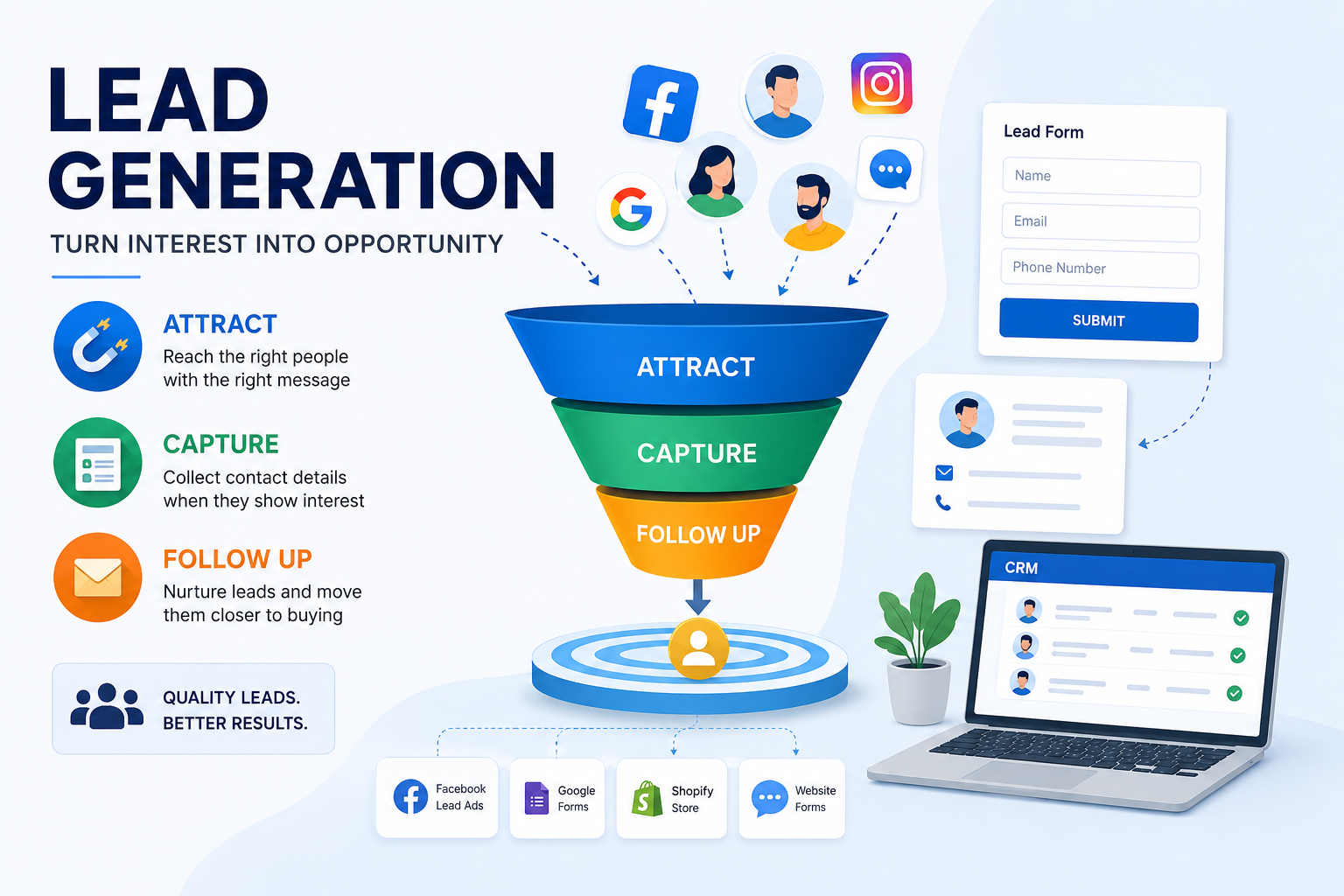
Lead generation is the process of attracting potential customers, capturing their contact information, and following up to turn them into qualified leads and, ultimately, customers. It can include channels such as Facebook, Google, websites, online forms, and referrals.
What Counts as a "Lead," Exactly?
A lead is simply a person who's shown some interest in what you offer, and given you a way to follow up with them — usually their name and contact details. That could be someone who:
- Filled out a contact form on your website
- Clicked a Facebook or Instagram ad and submitted their number
- Signed up for a free trial or demo
- Left their email for a discount code
- Asked a question through your online store's chat
Not every lead is equally serious. Someone who just downloaded a free guide out of curiosity is very different from someone who filled out a "request a quote" form. That's usually described as the difference between a cold lead and a warm (or hot) lead — but either way, they're a lead the moment they've given you a way to reach them.
Why Lead Generation Matters
Here's the thing most businesses eventually realize: you can have the best product in the world, but if nobody knows it exists, it doesn't matter. Lead generation is the bridge between "people who might want what you sell" and "people you can actually talk to about buying it."
Without it, sales becomes entirely dependent on luck — walk-ins, word of mouth, whoever happens to stumble onto your website. With it, you have a steady, somewhat predictable stream of people to actually follow up with.
How Lead Generation Actually Works
At a basic level, lead generation follows a simple pattern:
Attract → Capture → Follow Up
Attract — You put something in front of people that catches their interest. This could be a Facebook ad, a Google search result, a social media post, or even a physical flyer with a QR code.
Capture — The person takes an action that gives you their contact information. Usually this means filling out a form, but it can also be a chat message, a phone call, or a comment with their number.
Follow up — Someone (or something automated) reaches out to move that person further along — answering questions, sending more info, or setting up a call.
The "attract" and "capture" parts get most of the attention because they're visible — ads, landing pages, forms. But the "follow up" part is where deals are actually won or lost, and it's the part businesses most often drop the ball on.
Common Lead Generation Channels
There's no single "correct" way to generate leads — it depends heavily on your business and your audience. Some of the most common channels:
Paid ads (Facebook, Instagram, Google) — You pay to show your offer to people who match a certain audience. Facebook Lead Ads, specifically, let people submit their info without ever leaving the app — which increases how many people actually complete the form, but also means the lead needs to land somewhere trackable, fast.
Website forms — Someone visits your site organically (through search, social media, or a referral) and fills out a contact or inquiry form.
Google Forms and landing pages — Often used for specific campaigns — a webinar sign-up, an event registration, a downloadable guide.
E-commerce inquiries — On platforms like Shopify, a lead might come from a product question, a "notify me when back in stock" request, or a pre-purchase chat.
Referrals and word of mouth — Not automated, but still a lead generation channel — someone tells a friend, and that friend reaches out.
Most businesses end up using a mix of these rather than relying on just one. Which is exactly where things start to get messy.
The Part Nobody Talks About: What Happens After the Lead Comes In
This is genuinely the most overlooked part of lead generation. Businesses spend real money running ads and building landing pages to generate leads — and then those leads sit unanswered in an inbox, a spreadsheet, or a Facebook Ads Manager tab nobody checks regularly.
It sounds almost too simple to be a real problem, but it's incredibly common. A lead fills out a Facebook Lead Ad form, and unless someone's specifically checking that dashboard, that lead might not get a follow-up for days — by which point they've probably already gone with a competitor who called first.
This is really the bridge between lead generation and CRM. Generating a lead is only half the job. The other half is making sure that lead is captured somewhere visible, assigned to someone, and followed up with quickly — which is exactly what a CRM is built to handle. If leads from your ads, forms, and store all flow automatically into one place — the way GreenCRM24 pulls in leads directly from Facebook Lead Ads, Google Forms, and Shopify — there's no gap where a lead can quietly sit unanswered.
Quality Over Quantity
It's tempting to judge lead generation purely by volume — "we got 200 leads this month!" — but volume alone doesn't mean much if those leads aren't a good fit for what you sell. A hundred poorly-targeted leads that never convert are worth less than twenty well-targeted ones that actually turn into customers.
This is why targeting matters as much as the channel itself. Running ads to a broad, generic audience might generate more leads on paper, but following up with people who were never really interested wastes time your team could spend on leads that actually convert.