
Businesses use many different tools every day—websites, advertising platforms, forms, eCommerce stores, communication apps, and sales tools. The challenge is making all these tools work together. This is where native CRM integrations become important.
What Are Native CRM Integrations?
A native CRM integration is a connection built directly between a CRM and another software platform.
Instead of manually moving information between different systems, connected tools can share relevant data with the CRM.
A simple example is:
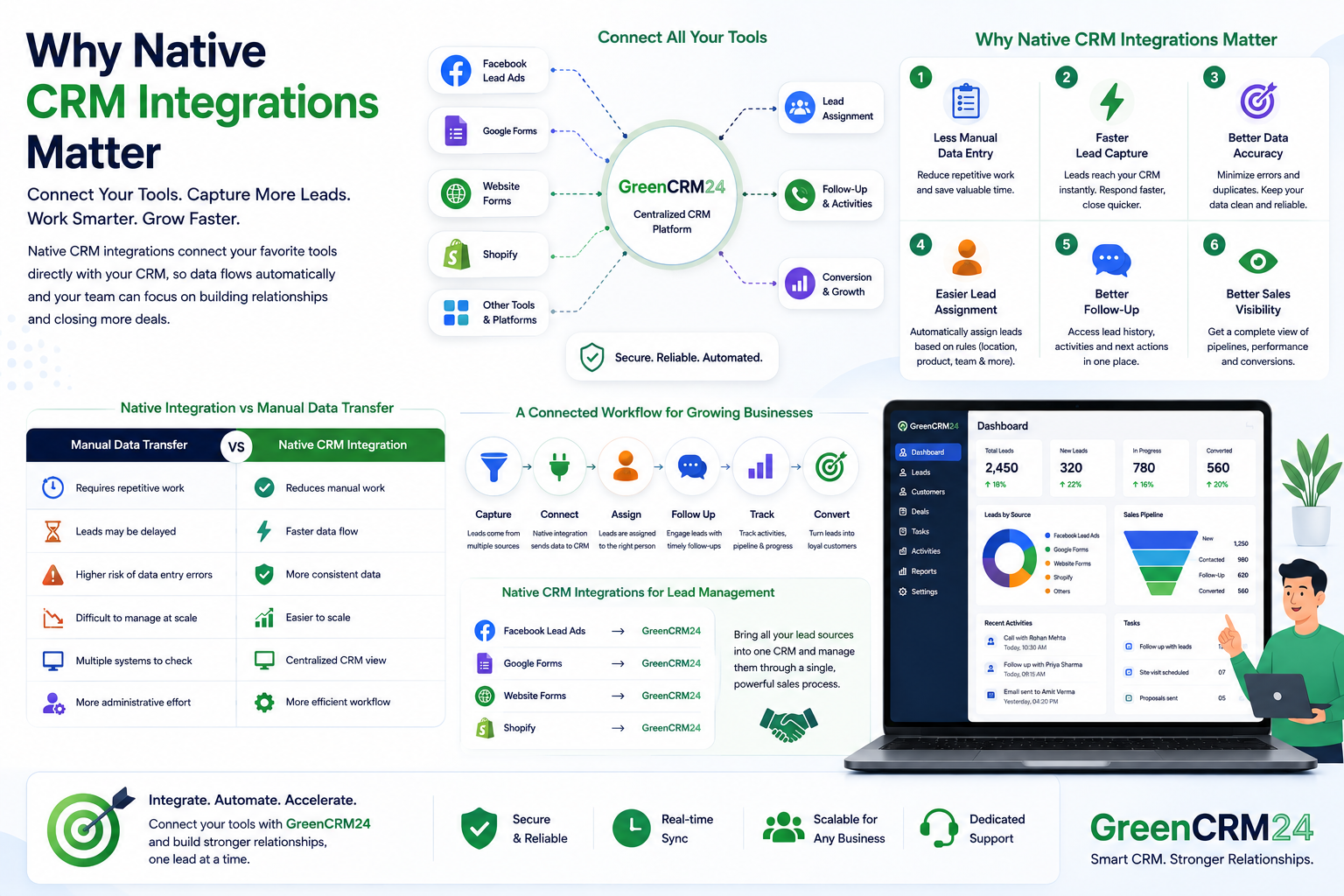
Lead Source → CRM → Lead Assignment → Follow-Up → Conversion
This creates a smoother flow of information across the sales process.
Why Do Native CRM Integrations Matter?
1. Less Manual Data Entry
Without integration, teams may need to download leads, copy information, or update multiple systems manually.
Native integrations can reduce this repetitive work and save valuable time.
2. Faster Lead Capture
When a customer submits an enquiry through a connected platform, the lead can reach the CRM quickly.
This helps sales teams respond without waiting for someone to manually transfer the information.
3. Better Data Accuracy
Manual data entry can result in spelling mistakes, duplicate records, or missing information.
Automated data transfer can help keep customer information more consistent between connected systems.
4. Easier Lead Assignment
Once a lead enters the CRM, it can be assigned to the appropriate salesperson based on business rules such as location, product, territory, or team.
This creates a more organized lead management process.
5. Better Follow-Up
When lead information and activities are available in the CRM, sales teams can manage follow-ups more easily.
They can see lead status, previous activities, and pending actions from one place.
6. Better Sales Visibility
Managers don't need to check multiple platforms to understand what is happening with their leads.
A connected CRM can provide a centralized view of lead activity, sales progress, and conversions.
Native Integration vs Manual Data Transfer
| Manual Data Transfer | Native CRM Integration |
|---|---|
| Requires repetitive work | Reduces manual work |
| Leads may be delayed | Faster data flow |
| Higher risk of data entry errors | More consistent data |
| Difficult to manage at scale | Easier to scale |
| Multiple systems to check | Centralized CRM view |
| More administrative effort | More efficient workflow |
Why Native Integrations Are Useful for Growing Businesses
As a business grows, the number of leads and customer interactions also increases.
Managing information manually may work in the beginning, but it becomes harder as the volume increases.
Native integrations help create a connected workflow:
Capture → Connect → Assign → Follow Up → Track → Convert
This allows marketing, sales, and customer service teams to work with the same customer information.
Native CRM Integrations for Lead Management
For businesses generating leads from multiple sources, integrations can be especially valuable.
For example:
Facebook Lead Ads → CRM
Google Forms → CRM
Website Forms → CRM
Shopify → CRM
Instead of keeping lead information in separate platforms, businesses can bring relevant information into their CRM and manage it through one sales process.
GreenCRM24 and CRM Integrations
GreenCRM24 is designed to help businesses manage leads, assignments, follow-ups, and sales activities from a centralized CRM platform.
By connecting lead sources and business tools with CRM workflows, companies can reduce manual work and create a more organized way to manage customer opportunities.
Conclusion
Native CRM integrations are more than simple connections between software tools.
They help businesses create a connected sales process where information can move from lead generation to CRM management, assignment, follow-up, and conversion.
For growing businesses, reducing manual data entry and keeping customer information organized can make the sales process faster and easier to manage.
Connect your tools. Capture your leads. Automate your workflow. Grow your business.
Frequently Asked Questions
What is a native CRM integration?
A native CRM integration is a direct connection between a CRM and another software platform, allowing relevant information to move between the systems.
Why are native CRM integrations important?
They can reduce manual data entry, improve data consistency, speed up lead capture, and create a more connected sales workflow.
Are native CRM integrations useful for small businesses?
Yes. They can help small businesses reduce repetitive work and build an organized sales process as they grow.
Can CRM integrations help with lead assignment?
Yes. Once a lead reaches the CRM, assignment rules can help route it to the appropriate salesperson or team.